Croatia's light pollution law: what cities must do by 2032
Zero uplight, 3000 K, a midnight curfew and a 2032 deadline: the Croatian law and its 2020 regulation explained for municipalities, article by article.

 Guide · Croatia
In diesem Artikel
Croatia has one of the stricter light pollution laws in the EU, and most of its obligations fall on cities and municipalities. This is what the Law on Protection from Light Pollution (NN 14/2019, in force since April 2019) and its regulation (Pravilnik, NN 128/2020) require. Article numbers are given so every claim can be checked against the source.
The luminaire rule: 0% up, 3000 K
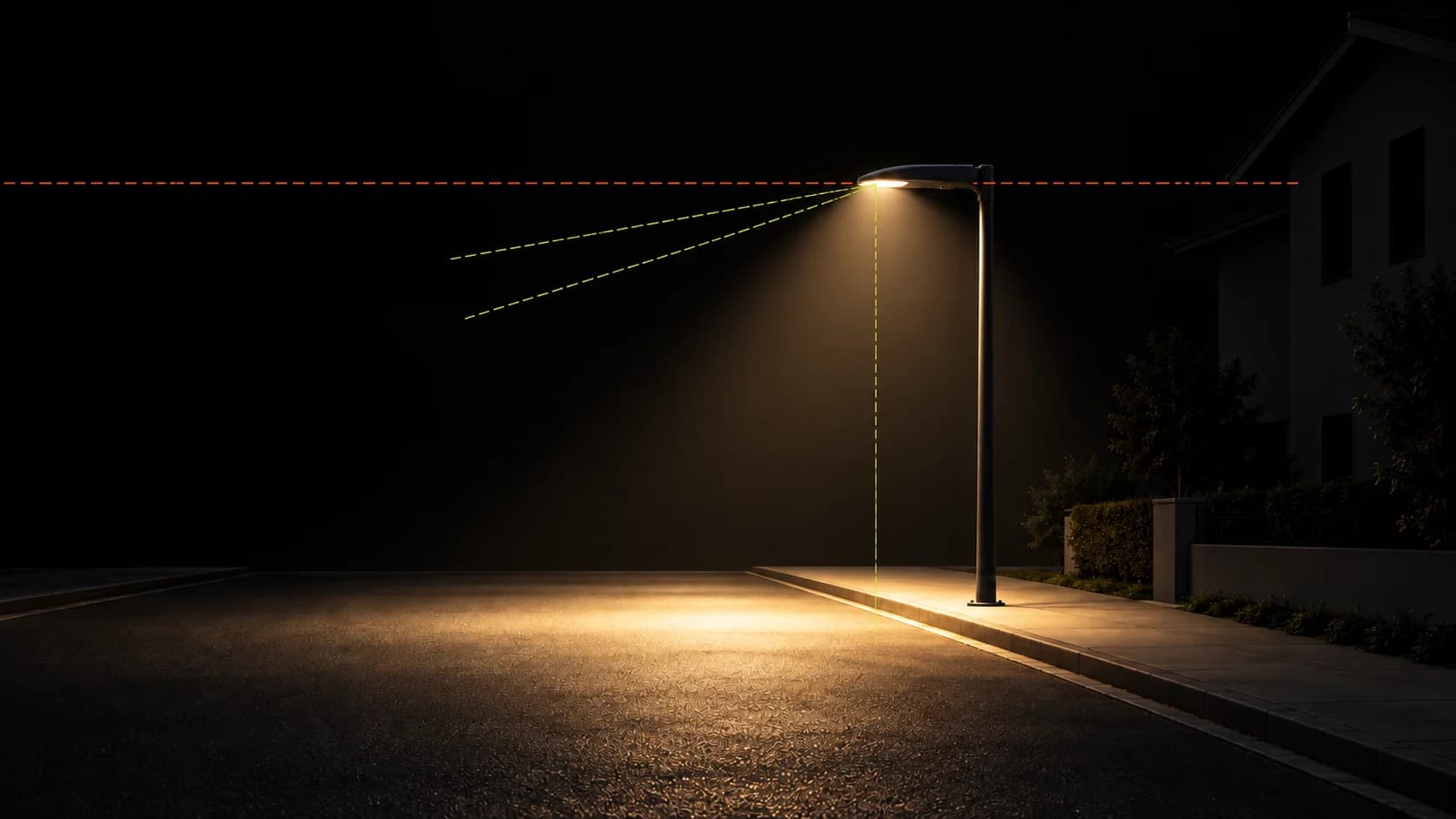
Article 5 of the law defines an ecologically acceptable luminaire: 0.0% of its light above the horizontal plane and a colour temperature of at most 3000 K. Protected areas tighten that to 2200 K. Decorative lighting may point upward only if the light stays within the object it lights.
Five zones, five limits
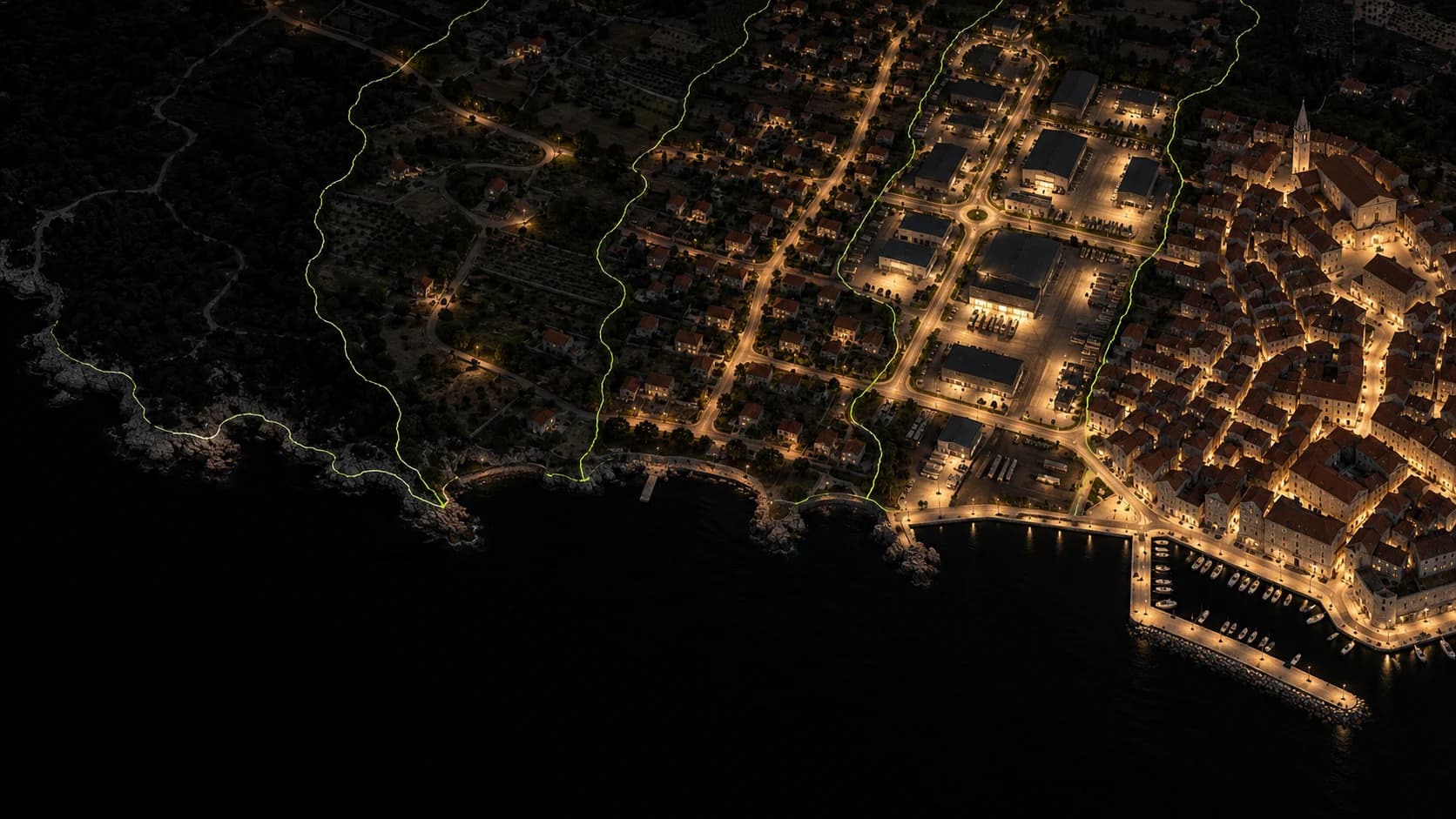
The Pravilnik (Article 5) divides territory into zones from E0 (dark sky parks, strict reserves) through E1 (rural, protected areas), E2 (residential), E3 (industrial, traffic) to E4 (urban centres with intense night activity). Each municipality assigns the zones in its lighting plan, and the zone sets the limits:
- Upward light after installation: E0 and E1 0%, E2 1%, E3 2%, E4 3% (Annex VIII).
- Light on windows before and during the curfew: E2 2 and 0.5 lx, E3 3 and 1 lx, E4 8 and 2 lx (Annex II).
- Facade luminance: none in E0 and E1, 5, 10 and 20 cd/m² in E2, E3 and E4 (Annex II).
≤ 2200 K
≤ 2200–3000 K
≤ 3000 K
≤ 3000 K
≤ 3000 K
The midnight curfew
Reduced lighting starts at midnight and lasts at least three hours (Article 7). Road lighting drops to the curfew values in Annex III, decorative lighting is cut by at least half or switched off, landscape lighting goes off (Articles 10, 14, 24).
- Road lighting: down to the curfew values in Annex III.
- Decorative lighting: at least −50 %, or off. Must dim 100 → 0 %.
- Landscape lighting: off.
- A lighting plan may shift the start by up to one hour.
Deadlines, inspections, fines
- Lighting plan and action plan for the whole territory, due 12 months after the Pravilnik (Articles 28 and 29).
- All existing lighting aligned with the law within 12 years of the Pravilnik (Article 30): November 2032.
- Oversight by the environmental inspectorate; electrotechnical and market inspections cover measurements and products (Article 16).
- Fines for operators from 25,000 to 100,000 kuna, about 3,300 to 13,300 euros (Article 26).
- Apr 2019Law in force (NN 14/2019)
- Nov 2020Pravilnik in force (NN 128/2020)
- Nov 2021Lighting plans and action plans due
- Sep 2026This article
- Nov 2032All existing lighting aligned
EN 13201 and the law, in one design
The road lighting norm says how much light a road needs (class M for traffic, P for pedestrians). The law says how much may escape, in which colour, and when it must go down. Starting from a catalogue luminaire usually means over-lighting to cover the weakest point of the road, and that surplus is what the law limits. Starting from the street removes the conflict: Taman calculates the distribution that meets the class at minimum flux, with 0% uplight by construction. In Pula that was 45.8% less luminous flux for the same classes.
One reminder that a zone on paper is not protection: Petrova gora, Croatia's first International Dark Sky Park, lost its status after a telecommunications tower with bright signalling lights was built inside it. Only Vrani kamen on Papuk remains.
Zakon o zaštiti od svjetlosnog onečišćenja (NN 14/2019) and Pravilnik o zonama rasvijetljenosti (NN 128/2020).
We design to EN 13201 and the light pollution law in one pass, for a street or a whole municipality.

Lighting designer with more than 35 years in architectural and urban lighting and over 50 international awards. Founder of Taman.